
Prepare Your Wooden Export Packaging for PPWR
Since 12 August, there’s a new EU regulation sitting over every shipment that lands in Europe. It’s called PPWR, the Packaging and Packaging Waste Regulation, and the thing worth knowing up front is that it doesn’t care where your factory is. It cares where your goods arrive. Ship into Rotterdam, Hamburg or Antwerp and your packaging is now inside European law. Not just your customer’s problem. Yours.
That’s the uncomfortable version. The comfortable version, which almost nobody is telling wooden-packaging exporters, is that this regulation actually plays in your favour if you handle it properly. More on that shortly.
It's not ISPM-15. Don't let anyone tell you it is.
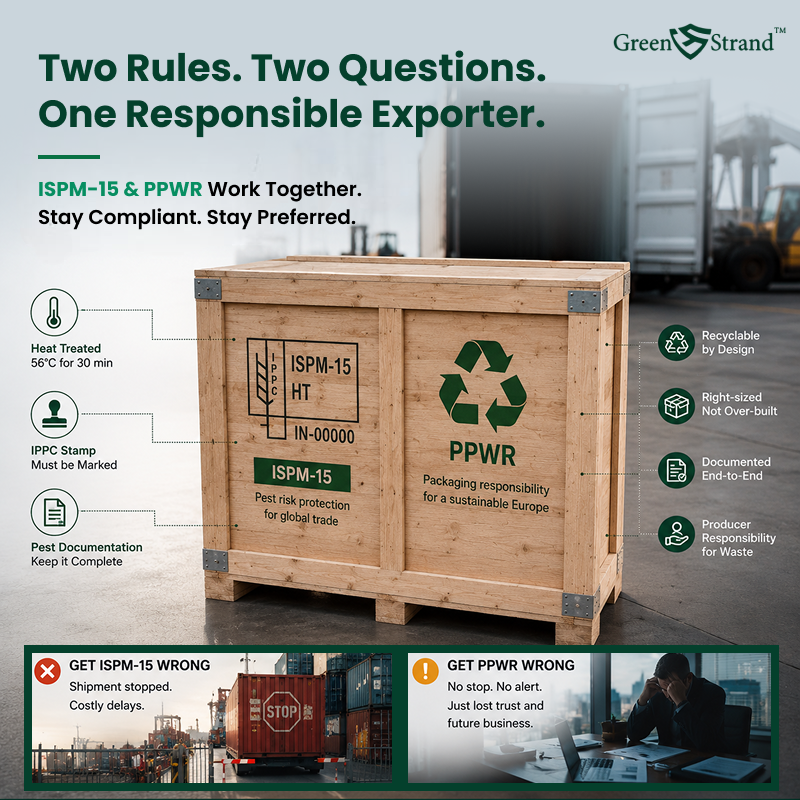
If you ship on wood you already live with ISPM-15: the heat treatment, the IPPC stamp, the pest paperwork. Keep every bit of it. PPWR sits on top of that, it doesn’t replace it.
The two rules ask different questions. ISPM-15 wants to know whether your wood carries pests. PPWR wants to know whether your packaging can be recycled, whether it’s over-built, whether you can document it, and who pays to deal with it once it becomes waste in Europe.
Get ISPM-15 wrong and your wood gets stopped at the port. Get PPWR wrong and nothing dramatic happens at first. You just become the supplier whose paperwork creates headaches, and a few months later the reorder goes somewhere easier. The second failure is quieter, and it costs more.
Why wood comes out ahead
Most of the alarm you’ll read online was written for the plastics people, and they have real reasons to worry: multi-layer pouches, mixed materials, recycled-content targets they can’t hit. That isn’t your world.
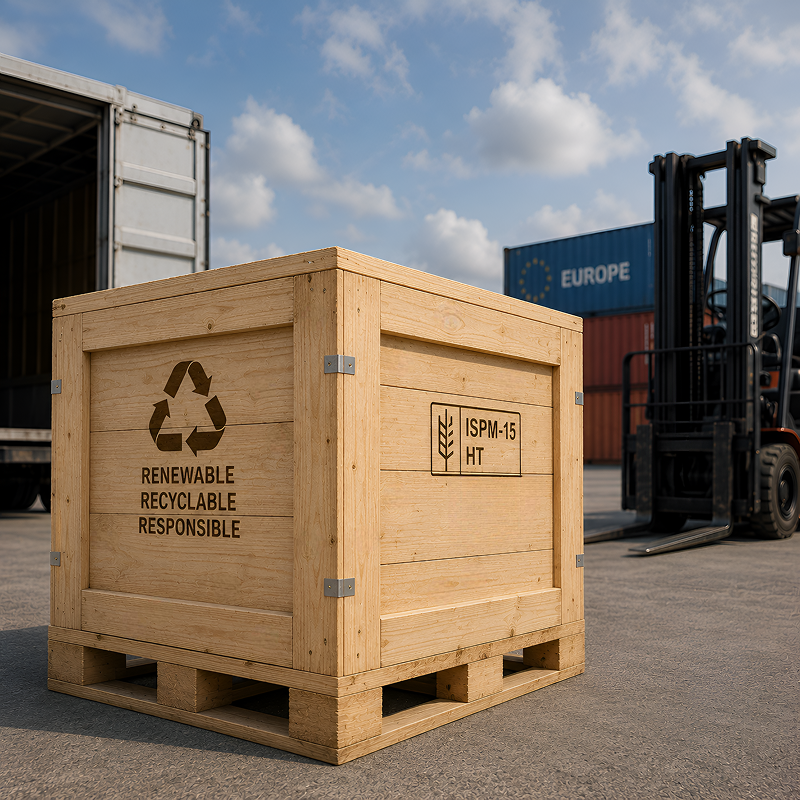
Wood is renewable and it’s recyclable. It’s also clean on the chemicals PPWR is actually chasing. The heavy-metal and PFAS limits that are keeping plastic-packaging teams up at night barely register for an honest wooden crate. And the EU’s own guidance has confirmed that wooden pallets in active use for imports and exports are exempt from the reuse rules that are pushing other formats into expensive redesigns.
So the material you already make walks into this regulation with an advantage. That’s rare, and it’s worth using. The exporters who work that out this year will be selling on it by 2028. The ones who don’t will spend those years apologising for documents they never got round to preparing.
The parts that actually bite from day one
Enough principle. Here’s what to watch.
Right-sizing
PPWR clamps down on excessive packaging. For transport and grouped packaging there’s a cap on empty space, with the headline figure set at 40%. Over-engineered crates and reflexive double-boxing used to look like care. Now they look like a design fault you have to justify.
What's on the wood
There are limits on heavy metals in packaging. Clean, untreated timber is fine. The risk creeps in through treatments, paints, coatings and sometimes the fittings. You need to be able to say what’s on your wood, not only what it’s made of.
Documentation
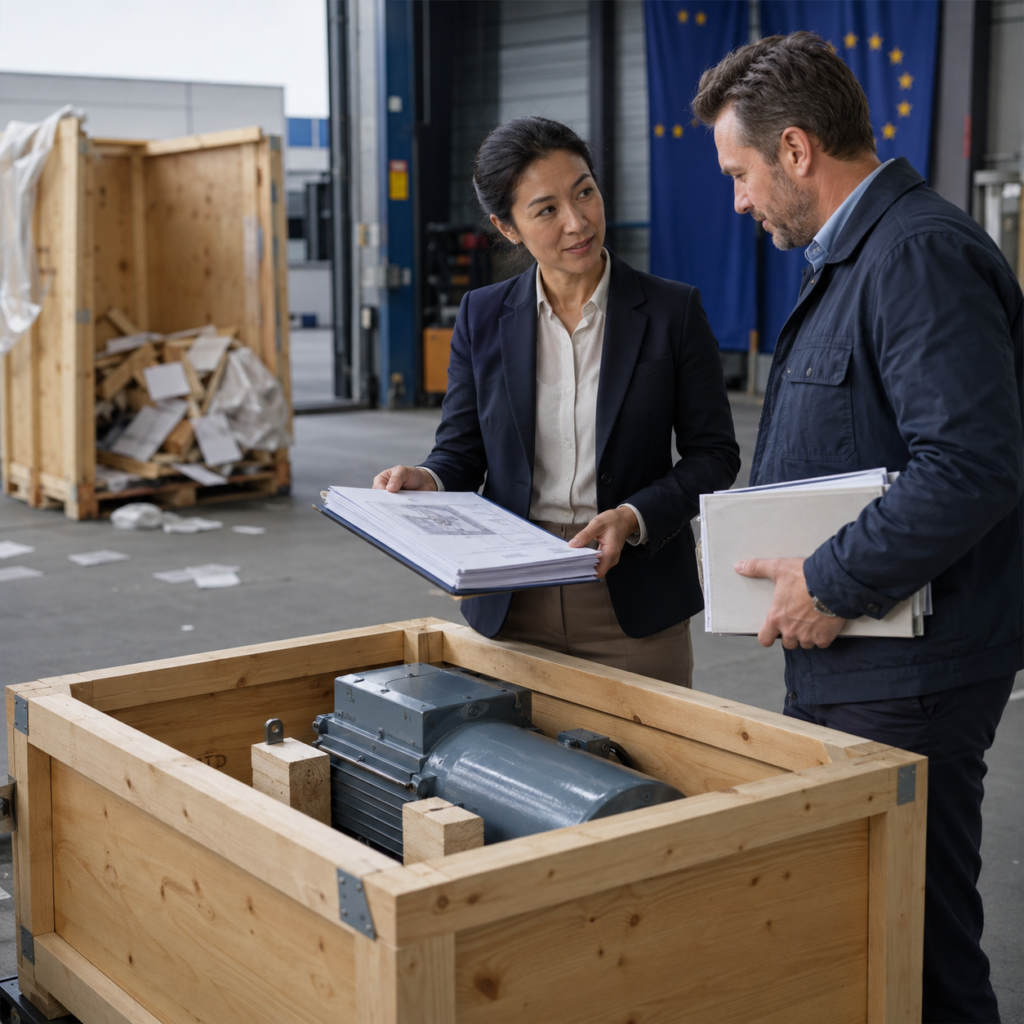
This is the one people wave away, and it’s the one that gets them. From the start you’re expected to hold a technical file and a Declaration of Conformity that prove your packaging meets the design and recyclability criteria. Your word isn’t proof. If a European buyer asks for that file mid-audit and you can’t produce it, you’re the gap in their compliance, and buyers close gaps by changing suppliers.
EPR
Extended Producer Responsibility means someone has to register in each EU country, report packaging by weight and material, and pay into the waste system. Which brings up the question everyone gets wrong.
Who actually carries this, honestly
Here’s the bit the scarier articles skip, because it’s less exciting. For most business-to-business shipments, the “producer” who registers and pays is whoever first places the packaging on the EU market. Usually that’s your importer, not you.
So why does it end up on your desk anyway? Because your buyer knows that too, and their instinct when a new cost and a pile of new reporting shows up is to push it back up the chain to whichever supplier makes it easiest. Turn up with right-sized packaging, a clean statement of what’s in it, and a Declaration of Conformity ready to hand over, and you’re not just compliant. You’re the supplier who doesn’t create work. In a tight market, that’s the one who keeps the order.
PPWR isn’t only a compliance deadline. It’s a moment where buyers quietly re-rank their suppliers. Better to be on the right side of that.
A checklist before your next European shipment
If you can’t tick a line, that’s where your work is.
- We know exactly which packaging enters the EU: pallets, crates, boxes, dunnage, wrapping. Not just the product carton.
- Our packaging is sized to the job, with no reflex double-boxing.
- We can say what’s on our wood (treatments, coatings, paints, fittings) and confirm it sits within the limits.
- We treat ISPM-15 and PPWR as two separate obligations, and still do both.
- We can produce a Declaration of Conformity and technical file for each packaging type on request.
- We’ve asked our EU buyers who is registered as the “producer” for EPR, and what they’ll need from us.
- We know the later deadlines are coming (recyclability grading, labelling and reuse rules phase in through 2030) and we’re designing for them now.
Most exporters can tick three of these today. The other four are the whole opportunity.
Talk to us before your buyer talks to your competitor
We make wooden pallets, boxes and crates for exporters across Delhi NCR, out of our units in Gurugram and Faridabad, and we’re already building packaging specs with PPWR in mind: sized properly, honestly documented, with the export paperwork your European customers can pass straight to their auditors.
Send us your current packaging spec and where it’s headed. We’ll go through it, tell you where you’re exposed, and show you how to fix it before it costs you an order.
Contact the Greenstrand team, or call +91 8448581799 / email – sales@greenstrand.in
Wood was always the sensible material. PPWR just turned that into something you can prove on paper.

Exporting to the EU? Check Your Packaging Before Your Next Shipment.
Share your wooden packaging specifications and export destination. Our team will review your pallets, boxes or crates and help identify areas that may require attention.